The journal
How to read a nootropic supplement label in India
Reviewed 12 July 2026 · Educational content, not legal or medical advice.
A polished front label can make almost any supplement sound advanced. The back label is where the product becomes auditable. In India, health supplements and nutraceuticals sit inside an FSSAI regulatory framework covering composition, labelling and claims. A careful buyer should still do more than look for an FSSAI number.
1. Identify what the product claims to be
Look for the product category and the required statement “NOT FOR MEDICINAL USE.” A supplement should not present itself as a treatment for ADHD, anxiety, insomnia, depression, dementia or any other disease. Disease-treatment language is not made legitimate by adding an asterisk.
2. Find the serving size before reading the ingredient list
“500 mg per serving” is meaningless until you know whether a serving is one capsule, four capsules or two scoops. Check:
- capsules or scoops per serving;
- servings per container;
- recommended daily usage;
- whether the marketing headline quotes a per-capsule or per-serving amount.
3. Demand an amount for every active ingredient
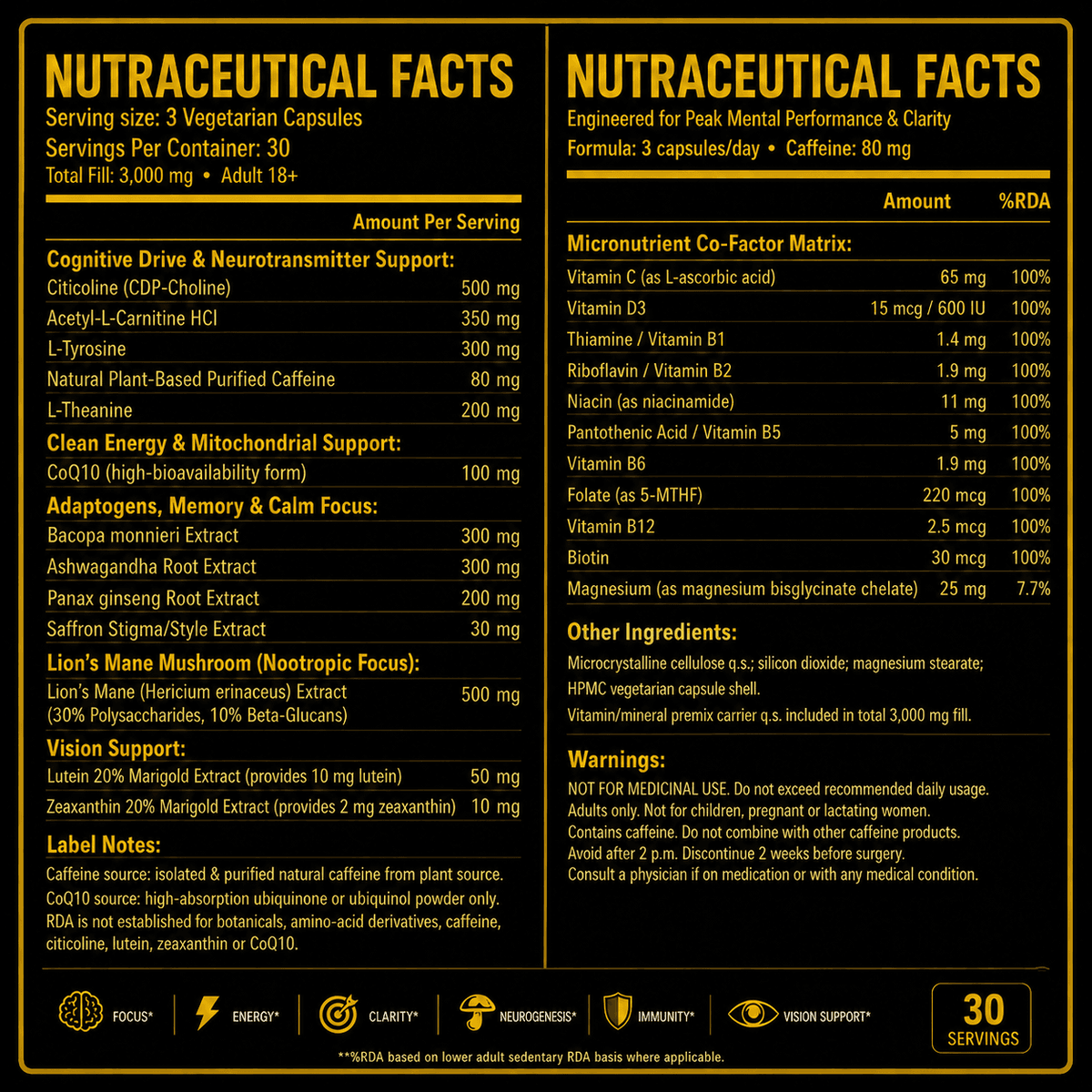
A proprietary blend may disclose the total weight while hiding each component’s amount. That prevents you from comparing the label with human research, checking your total stimulant exposure, or knowing whether one inexpensive ingredient makes up most of the blend.
An open-label formula prints each active ingredient and its quantity. That still does not prove efficacy, but it gives you the minimum information needed to investigate the formula.
4. Count total caffeine, not just the word “caffeine”
Caffeine may come from coffee, tea, guarana or another extract. Add every source across supplements and drinks. Then consider timing. A moderate morning dose can still be a bad late-evening choice for someone whose sleep is sensitive.
NEURA MIND 2.0 prints 80 mg caffeine per serving. Awareness Stack prints zero caffeine. The important feature is not that one option is universally better; it is that the choice is visible.
5. Separate an ingredient study from a finished-product claim
If a study tested 500 mg of one ingredient for 12 weeks in older adults, it does not automatically validate a 100 mg multi-ingredient blend marketed for instant student focus. Check the dose, duration, population, outcome and study design. Also look for reviews or regulatory assessments that disagree with a single positive study.
6. Read warnings as carefully as benefits
Look for age restrictions, pregnancy and breastfeeding warnings, medication or medical-condition cautions, allergen information, maximum daily use, storage instructions and drowsiness or stimulant warnings. A responsible label tells some people not to buy the product.
7. Check traceability
Confirm the manufacturer or marketer identity, contact information, batch or lot details, manufacturing and expiry dates, net quantity, customer-care route and applicable FSSAI licence information on the physical product. A licence number is a compliance signal; it is not proof that every marketing claim has strong clinical evidence.
A 60-second buyer checklist
- Every active ingredient has an exact amount.
- Serving size and servings per bottle are clear.
- Total caffeine is stated and fits your tolerance.
- No disease-treatment promise appears.
- Warnings and recommended usage are readable.
- Research claims match the actual dose and population.
- Business, batch, expiry and licence information are traceable.
Official sources
- FSSAI: Health Supplements and Nutraceuticals resource page.
- FSSAI compendium of health supplement and nutraceutical regulations.
NEURAMIND’s standard is simple: if a dose matters, it belongs on the label. Browse the open-label system or read our evidence review of citicoline.